
 Anal Beads
 Anal Vibrators
 Butt Plugs
 Prostate Massagers
 Alien Dildos
 Realistic Dildos
 Kegel Exercisers & Balls
 Classic Vibrating Eggs
 Remote Vibrating Eggs
 Vibrating Bullets
 Bullet Vibrators
 Classic Vibrators
 Clitoral Vibrators
 G-Spot Vibrators
 Massage Wand Vibrators
 Rabbit Vibrators
 Remote Vibrators
 Pocket Stroker & Pussy Masturbators
 Vibrating Masturbators
 Cock Rings
 Penis Pumps
 Wearable Vibrators
 Blindfolds, Masks & Gags
 Bondage Kits
 Bondage Wear & Fetish Clothing
 Restraints & Handcuffs
 Sex Swings
 Ticklers, Paddles & Whips


Why Sexual Performance Anxiety Occurs—And How to Deal with It
Read in 8 minutes
Losing an erection, struggling to get wet, or feeling like your mind is spinning during sex can feel isolating. But it’s an experience you share with millions of people around the world – sexual performance anxiety.
As a sex therapist, I’ve helped countless people break this cycle.
One of the most important parts of doing this is understanding why this is happening in the first place. Because when we feel like we’re failing in bed, or that something’s wrong with our body, stress increases (and the likelihood of it happening again increases—arguably one of the worst parts of performance anxiety).
I spoke with Dr. David Rowland and Dr. Evie Kirana, leading researchers and clinicians in the field of sexual function, to learn about sexual performance anxiety, why it occurs, and what practical help is available.
The good news is, it’s easier to fix than you think.
This article is based on this paper in Sexual Medicine Reviews.
Prefer to listen? Listen to the podcast episode below from Sleeping with Science: The Sex Podcast.
What exactly is sexual performance anxiety?
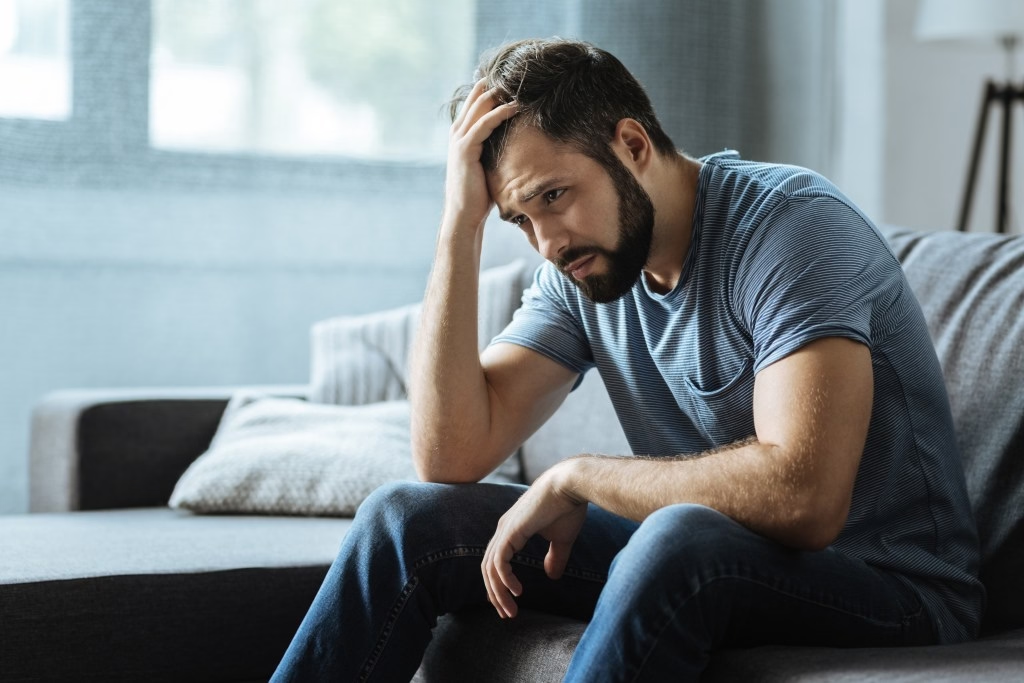
Sexual performance anxiety is when you worry so much about your performance—getting hard, staying hard, going long enough, pleasing your partner—that your body shuts down what it needs to make sex pleasurable.
Because when your brain senses a threat, even an imagined threat, like “I hope I don’t lose this again,” your body prioritizes survival over happiness. Your heart rate changes, your breathing changes, and blood flows efficiently from your genitals.
Arousal requires blood flow to occur.
Even though it feels like your body is working against you, it’s not. It just wants to protect you. A troubling neurobiological fact.
Sexual needs:
- relaxation
- Safety
- openness
- spiritual being
- Connection to touch and feeling
Anxiety requires the opposite:
- Be on high alert
- self-monitoring
- Evaluate
- prophecy
- Scan for threats
So if you’re stuck thinking, “Does this work?” or “Am I trying hard enough?” or “Have they lost interest?” — you’re in evaluation mode. Evaluation mode shuts down desire.
The Spiral: How Worry Becomes a Self-Fulfilling Prophecy
One of the worst parts about sexual performance anxiety is that the more you worry it will happen, the more likely it is to happen. Essentially, you’re trapped. You’re worried that you’ll lose your erection or feel less aroused, so you panic. When you panic, your brain becomes locked onto the fear of it happening again.
This fear can increase your anxiety before your next sexual encounter. Because anxiety reduces arousal—that the thing you fear will happen again
Not because there’s anything wrong with you, but because your nervous system is learning in real time. The guy who evolved to protect you from tigers gets involved in something that’s actually unnecessary.
Why “trying harder” makes things worse
Most of us deal with performance anxiety by trying harder. We put more pressure on ourselves in the hope that it will prompt our bodies to do what we want.
We suppress our anxiety, hide it, rush into sex, or wait desperately for an erection to return.
But the harder we try, the more we fall into the same psychological territory that stifles desire and sexual arousal. Just like trying to fall asleep by concentrating – the harder we try – the less likely it is.
Performance anxiety disappears when stress decreases, not when effort increases.
How to Overcome Performance Anxiety (Steps Backed by Science)
1. Allow anxiety (instead of trying to get rid of it)
I get it, this is the opposite of what most of us want to hear. Anxiety feels really bad. But this is the first step in stopping the vicious cycle.
Because when anxiety arises, your job is not to calm down or cheer up. Simply let the anxiety happen—don’t fight it, and don’t expect your high to magically fix itself when you’re anxious.
When you accept it, you effectively tell your nervous system that it is safe. There are no more tigers. And it makes it easier to shake off anxiety and wake up again.
2. Slow everything down
When anxiety strikes, adrenaline speeds everything up. Your mind starts racing a million miles an hour. Your heartbeat feels like a carnival beat, and the pace of sex can get lightning fast.
A common trap we fall into is thinking “Come on, I’m already hard, let’s go before I lose it”. That totally makes sense, right?
But the practical way to make your erection last is to slow everything down. This counteracts the biological shock and tells your body and brain that you are safe. With more security, you can experience more excitement.
3. Bring attention back to the senses
This is one of the most powerful tools that I use all the time with my clients in sex therapy and coaching.
By focusing on your senses, you shift your focus from assessment mode to your body. When you can feel the feel of someone on your lips, the warmth of their skin, the weight of their body, you anchor yourself to that moment.
Desire and arousal require this presence to flourish.
Want your libido back?
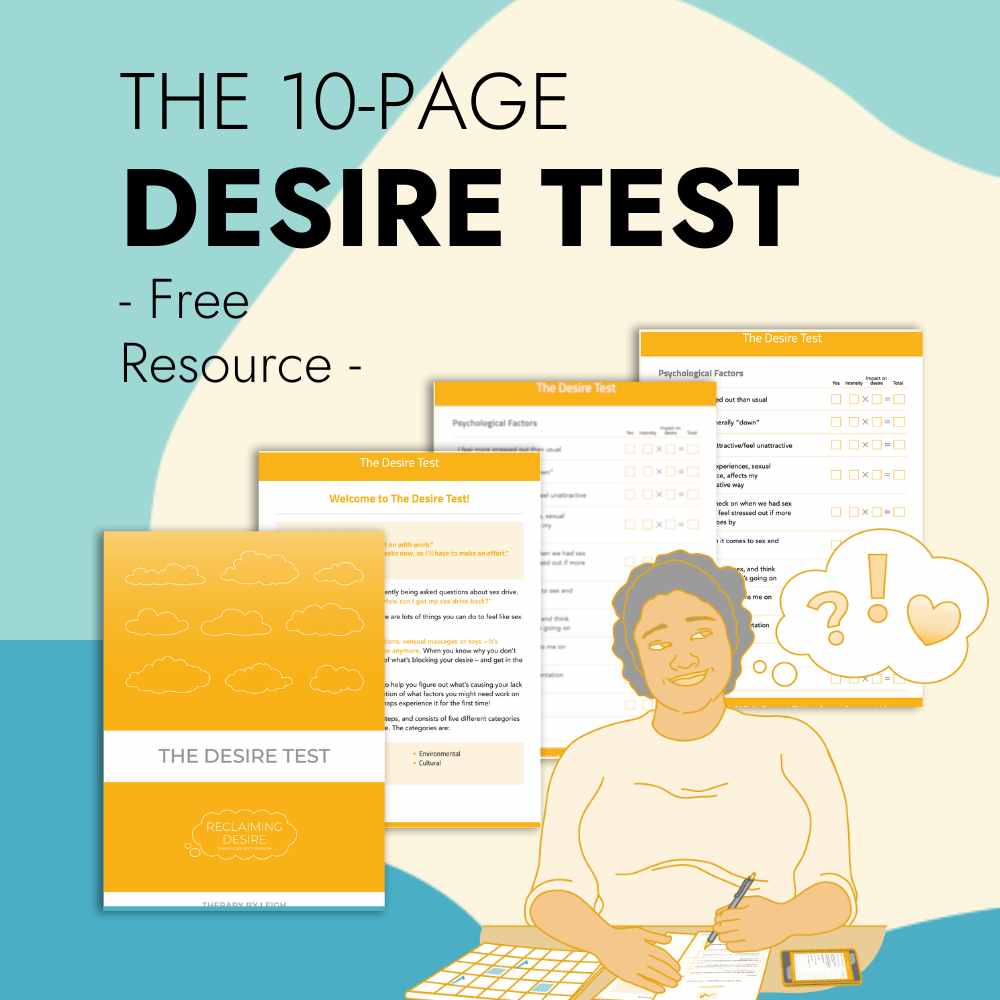
My free resource, The Desire Test, helps you take the first step toward increasing your libido by understanding your decline in libido.
Take the 10-page assessment quiz to get the answers you need, learn what’s holding you back, and get free sex and relationship tips delivered straight to your inbox. You can cancel your subscription at any time.
4. Replace performance goals with connectivity goals
Kirana & Rowland’s clinical model also focuses on “connection goals” as a way to overcome anxiety.
Common performance goals are the need to maintain effort, satisfy our partner, or reach orgasm. Whereas connection goals are more about feeling in sync with your partner, experiencing the moment as fully as possible, or staying in the present moment, no matter what.
When you focus on the connecting part with your partner and yourself, it relieves that pesky stress and, ironically, helps you achieve those old performance goals more easily.
5. Practice transparency (not hiding)
When we experience performance anxiety, our instinct is often to hide it. Because it feels shameful and it feels like something is really wrong. But hiding makes things worse.
Sharing with your sexual partner the things you sometimes think about if you’re losing arousal – and that they know you’re working on it, not them – can help.
This works well because you eliminate the fear of being “caught out” during sex. A harmonious and understanding sexual partner can also reduce feelings of shame. This all adds up to increased connectivity – signal security. And, (say it again after me), arousal requires safety.
6. Focus on touches that don’t require an erection
Choosing a form of contact that doesn’t have any “expectations” on your genitals is often a key part of overcoming performance anxiety. And, like anything else, it often feels like the opposite of what you want to do in the moment.
Our culture is very focused on physical arousal. Especially for those with penises, an erection can feel like an important part that needs to function immediately, otherwise sex is completely impossible.
But broadening your perspective on happiness and focusing on other things that feel good—can break negative patterns. And, in the long run, it can improve your sex life. Because our genitals are just one of many erogenous zones. When we only focus on having an erection, we forget that there are lots of other things that can make us feel good.
Over time, this willingness to have an erection resets your body’s connection to sex.
It no longer treats sex as a “test” to see if you can have intercourse or ejaculate. It considers sex to be stress-free – exactly what is needed for sexual arousal and pleasure.
Completely normal and completely reversible
Sexual performance anxiety often makes people feel like a complete failure. But that’s not the case – it’s common, and it doesn’t mean something is always wrong.
Once you understand how (and why) anxiety hijacks arousal, and learn how to reduce stress rather than increase it, your body can easily do what it normally does.
If you need professional, tailored support for your specific difficulties, registration is now open for my 1:1 coaching program, Re:Desire.
Based on my master’s degree in sexology and nearly a decade of experience, it’s designed to help you want and enjoy sex without stress, anxiety, or fear of “underperforming.”
Because your body is not broken yet. It just needs to feel safe again.